Ramesch Daha
Wien 1933 – 1935
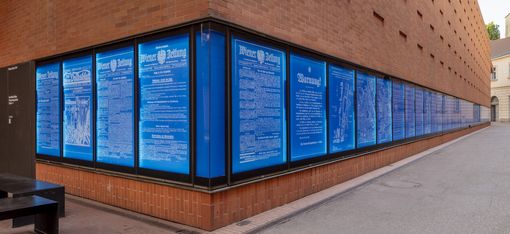
Kunsthalle Wien’s Vitrine in the MuseumsQuartier hosts an annual commission for a public artwork that can be visited at all times, day or night. “Wien 1933 – 1935” (2026) is a new work by Ramesch Daha (b. 1971, Tehran) transforming this space into a 62 metre lightbox.
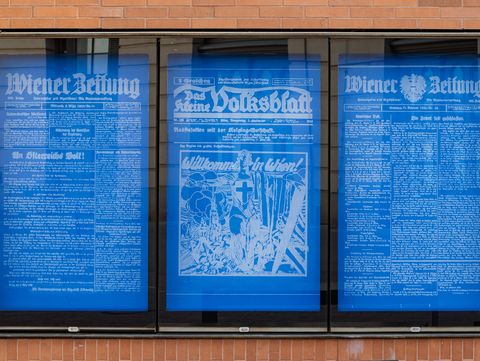
In a series of 45 drawings Daha explores the history of Vienna’s “Februarkämpfe” [February Uprisings]. The violent clashes between factions of the “Republikanischer Schutzbund”, the banned paramilitary arm of the Austrian Social Democratic Workers’ Party, and the authoritarian right-wing government of Chancellor Engelbert Dollfuss, marked a decisive moment in Austria’s political history, weakening resistance to the subsequent rise of National Socialism.
Daha’s practice investigates marginalised or overlooked historical narratives, often drawing on archival material such as maps, official documents and personal testimonies. In this work, she incorporates diary entries from Fritz Habeck, a 17-year-old resident of the Karl-Marx-Hof – one of the main centres of the “Februarkämpfe” – and the future chancellor Bruno Kreisky, alongside newspaper articles, maps and official records from the years 1933 to 1935. Each document is traced by hand onto paper, a physical gesture intended to confront history and consciously reckon with the past. The drawings are subsequently scanned, tinted and transferred to transparent film to make the images for the lightbox.
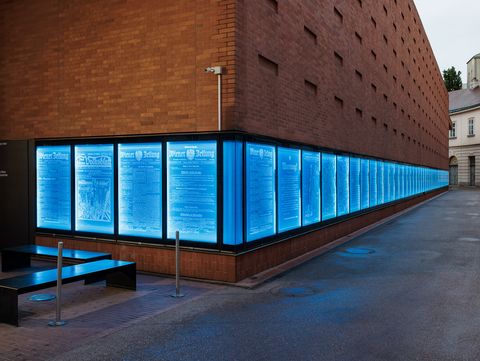
The work challenges conventional historical narratives, highlighting what is typically excluded or forgotten and emphasising the human story behind abstract data. Through this approach, events are rendered visible as both historical fact and lived experience, continuing Daha’s engagement with memory, documentation and the translation of archival material into contemporary art.
Produced for our recent group exhibition “Lebt und arbeitet in Wien”, Daha’s work remains on view until 25 April 2027 and can be visited free of charge at all times, day or night. The Kunsthalle Wien Vitrine is located on the south-west wall of the Kunsthalle building in the MuseumsQuartier.
Kunsthalle Wien
