The Roots of Small Fires
Milica Živković
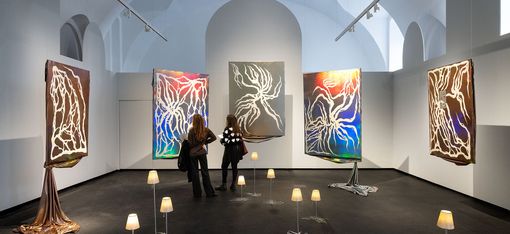
The Roots of Small Fires is the first institutional solo exhibition by multidisciplinary artist Milica Živković.
The exhibition weaves together personal narratives, material memory, and the complex historical and cultural dynamics of Southeast Europe. It also reflects a broader mission: to strengthen the region's cultural capital by building sustainable connections between artists, institutions, and shared expertise.
Milica Živković presents a large-scale installation of newly created works. Motifs from "The Roots of Small Fires" have accompanied the artist for several years, but here they are transferred into a new phase of her artistic practice.
Several motifs in the installation presented here refer in abstract form to the experience of returning to a place associated with ambivalent feelings, but also with resilience. The shimmering silver fabrics that serve as a painting surface allude to the pompous aesthetics of turbo-folk. This musical style, often associated with nationalism and the Yugoslav Wars, shapes Živković's memories of her childhood as a kind of background noise. The fabrics feature abstract, root-like forms that resemble gestures of uprooting and rooting. The paintings on the fabrics do not remain flat and confined within a defined frame in the conventional sense, but rather expand into the space – like roots that do not cling inextricably to the ground, but strive forward.
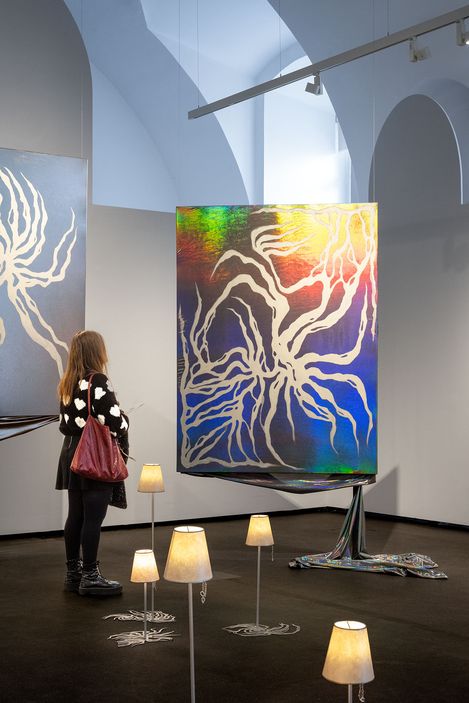
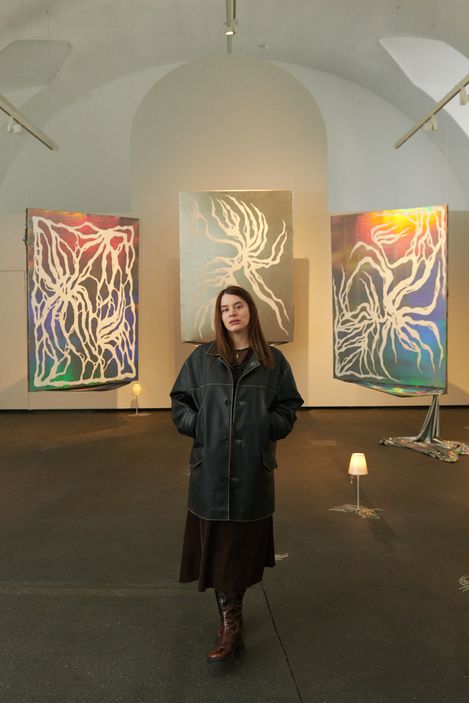
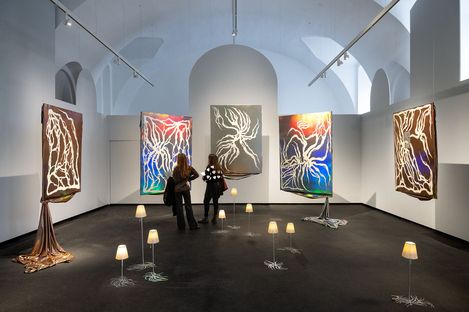
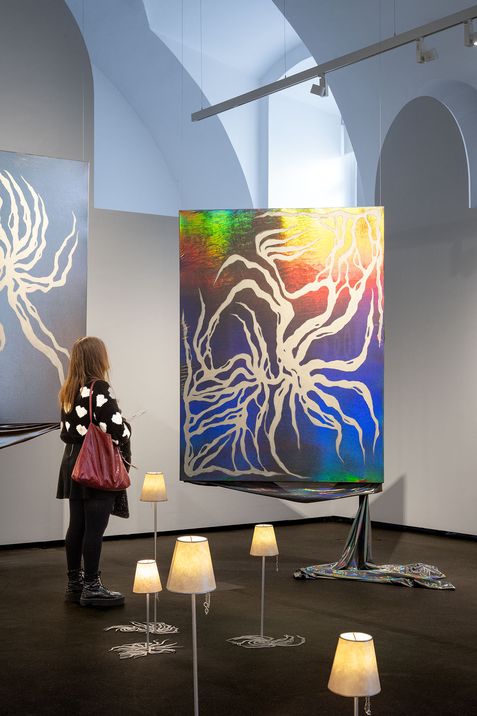
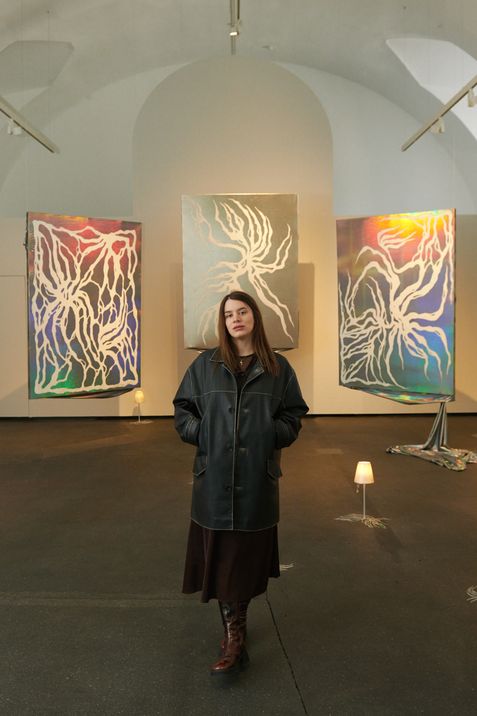
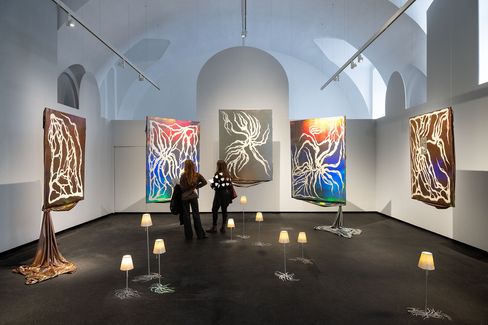
In "The Roots of Small Fires," visitors move across a stage of remembrance, a place on the threshold between the past and the future—an interplay of light and its absence.
The exhibition was realized by the UNIQA SEE FUTURE Foundation: Mentorship Program for Visual Artists in collaboration with artist and mentor Šejla Kamerić, Nomad – Croatian Office for Contemporary Art, Nomarts – Kunstverein zur Schaffung von Kunstsammlungen, and the MuseumsQuartier Wien. Most of the works presented were created during Milica Živković's two-month stay as MQ Artist-in-Residence in Vienna.
Curated by Astrid Peterle.
Artist Statement
„There is a shape that keeps returning to me – a claw, a flare, a flicker of light breaking through something dark. I have painted these shapes obsessively on shiny fabrics – synthetic silk, organza and iridescent artificial satin, that once belonged to the world of turbo-folk: the background noise of my childhood, that strange theatre of glitter and decay. Those fabrics shimmer like the nights in my hometown; wounded, ecstatic, pretending to be eternal. I think I paint them to understand what beauty means in a place that has seen too much of it, too easily, within the context that was very often everything but beautiful.
The shape first came to me as a wound, a small rebellion against the inside noise, and now it began to grow roots. Not roots that settle, but ones that wander. They stretch through metal, through paper and fabrics, through the faint memory of making things by hand when there was nothing else to do but survive. These forms reappear across paintings and objects, each time carrying new traces – scratches, seams, and layered gestures that echo the persistence of memory. With each new series of these objects and paintings comes new re-interpretation.
When I returned home after years of migrations, my hometown seemed heavier, as if its bones had turned to glass, metal and dust. Corruption had found its rhythm, and the spectacle was no longer pretending to be temporary. The past was everywhere, seductive, broken and familiar. I began to see the same root, the same claw, in the streets, in the gestures of people waiting for something unnamed to finally be resolved.
And there comes the lamp. Which, for me, represents a body that remembers.
In Balkan slang, to say a woman “looks like a lamp” is to objectify her beauty. I took that phrase and made it mine because it exposes the same distorted values my work confronts. I build lamps that hold the same paper shades from my childhood, but their stands now twist and turn into root-like forms, half organic, half industrial. They are remnants of both tenderness and resistance. They remember the factories, the hands of my father, the dust of metal, and the quiet laughter of trying to make something shine in the darkness.
In these new series, paintings mimic that transformation: monochrome gestures on shiny fabric, the same material worn by turbo-folk singers, representing a glittering backdrop to a society in collapse. They hold the tension between surface and depth, between the shine of spectacle and the dull ache of what lies beneath. I think of them as small altars to contradiction, to the way light can come from exhaustion, and how pain, when it finally roots itself, can grow into something luminous.
In the MQ Freiraum space, I imagine these works breathe in the light. The fabrics shift as the viewer moves, the lamps cast intimate and uneven shadows, and the gallery becomes a kind of stage for remembering. What was once private becomes spatial, a sort of dialogue between reflection and residue.
I no longer separate the personal from the political. They share the same pulse, the same soil. My work is that soil, tangled, reflective, and quietly alive. It begins with the claw, the claw transforms into the root, the leaf, the lamp; and ends somewhere between collapse and grace, where memory stops being history and finally overcomes it.”
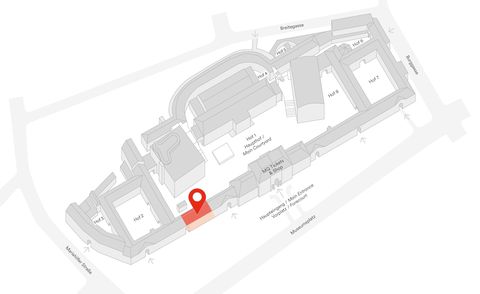
MQ Freiraum