Gonflable
Hans Kupelwieser
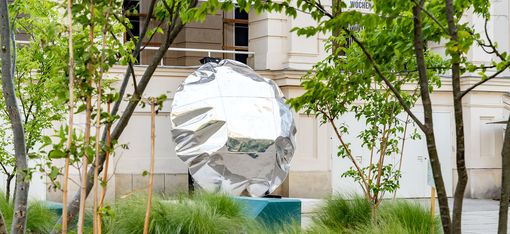
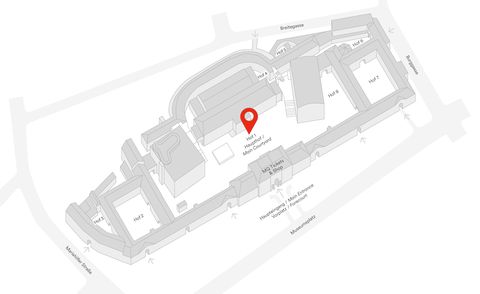
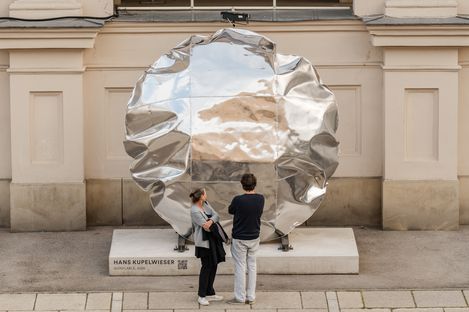
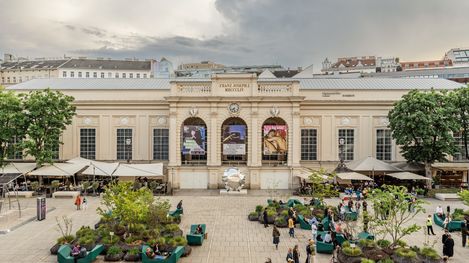
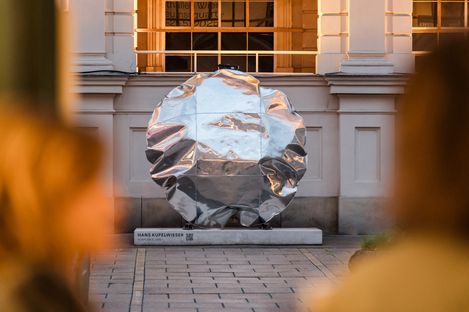
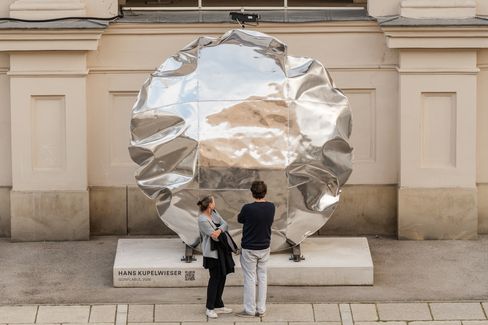
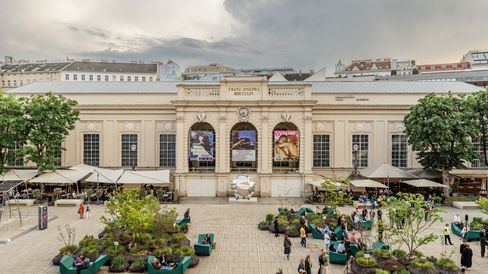
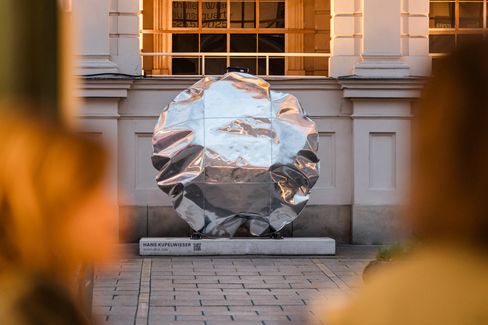
Prominently positioned in the MuseumsQuartier, a pneumatic sculpture by Hans Kupelwieser displays its full effect: A three-metre-wide Gonflable (from the French for ‘inflatable’) rests on a low plinth, leaning against the portico of the former riding school at the rear – directly in line with the main entrance.
Since the early 1990s, Kupelwieser has been developing this style of work using aluminium sheet metal, welded at the edges and inflated with compressed air. This controlled random process creates an organic-seeming form with dents, curves and kinks – apparently deliberate, yet actually shaped by the behaviour of the material and the airflow. The lightness of the form stands in a relationship of tension with the hardness and stability of the metal. Though created by air, the structure retains its volume even without internal pressure – a play with the illusion of material that is a fundamental characteristic of Kupelwieser’s work.
As a conceptual and media artist, Kupelwieser explores the boundaries between two- and three-dimensionality and experiments with unusual techniques using a wide variety of materials. His sculptures should not be understood as self-contained entities, but rather as part of an open system of forms, processes and transformations. In this way, he shifts the concept of repetition in the direction of difference: each variant is equivalent, each modification part of a larger context.
“I emphasize the relationships and interactions and demonstrate that all objects have different forms of appearance—I could also say: different states of matter” (translated)
Kupelwieser may call these works „Gonflables“, – but, contrary to what the name might suggest, they are made of metal rather than flexible plastic foil. The sculptures are created using high air pressure, which inflates the specially welded aluminium sheets and gives them their characteristic shape. This makes the aluminium appear simultaneously dynamic and light; the resulting surface structures defy complete control, emerging from an unpredictable interplay of pressure, material and form.
The reflective surface of this sculpture and its process-oriented creation open up a complex dialogue about place, material and perception. Beyond its physical presence, it references an artistic mindset that centres transformation, variation and development – a self-generating system in which each sculpture is both a starting- and an endpoint.
Curated by Verena Kaspar-Eisert.
Hans Kupelwieser was born in Lunz am See in 1948. From 1970 to 1973, he attended the Higher Federal Institution for Graphic Education and Research in Vienna. He went on to study at the University of Applied Arts Vienna from 1976 to 1982 under Herbert Tasquil, Bazon Brock and Peter Weibel. From 1995 to 2014, Kupelwieser was a professor at the IZK Institute for Contemporary Art at the Graz University of Technology. He has held numerous exhibitions in Austria and abroad and created various works in public spaces, including a memorial for the Jewish cemetery in Krems (1995) and the floating stage in Lunz am See (2004). Hans Kupelwieser lives and works in Vienna and Lunz am See.
MQ Main Courtyard