Videocity x Vienna
Through Odesa’s raw, unfiltered lens
Screening of films selected and introduced by Andrii Siguntsov.
Since early 2025, the Museum of Odesa Modern Art (MoOMA) and Videocity have been jointly curating video programmes in Odesa, Bern and Newcastle. MoOMA's curator Andrii Siguntsov has been invited to compile a selection from the museum's collection on the theme of “Posthuman”.
While addressing posthuman conditions, the selection also offers an overview of film and video art from the Odesa Oblast from the early 1990s to the present day.
“Even as we approach a posthuman horizon, our connection to humanity lies in our capacity to suffer, to endure and to wrestle with our transient bodies. These works dismantle the anthropocentric worldview, transporting us to realms where identity shatters and re-forms amid technology, trauma and temporal change.”
Welcome by: Mag. Yevheniia Rebrova, Embassy of Ukraine in the Republic of Austria; Dr. Walter Seidl, Curator
Introduction of the program by: Andrii Siguntsov, Chief curator of Museum of Odesa Modern Art
Artists: Dasha Chechushkova, Dmytro Ehrlich, Victor Malyarenko, Philip Perlovsky, Oleksiy Shmurak, AntiGonna, Ute Kilter and Olexandr Rojtburd
Lenders: MoOMA and a private collection for the work by AntiGonna
Videos and artists
Dmytro Ehrlich: Pigeons
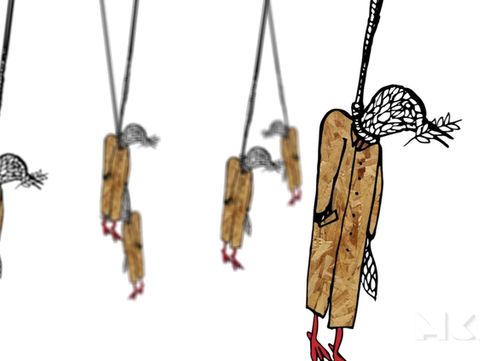
Dmytro Ehrlich’s video “Pigeons” lasts three minutes and a few seconds. During this time we fly through the hanged pigeons, which sway sometimes sharply, sometimes gently accompanied with sounds of Mozart’s Requiem and holding twigs of peace in their beaks.You can think that pigeons hang in groups – at some point two or three are very close to us, we fly past them and after a few bars of music we see another group in the distance. And so, it repeats many times. All pigeons are alike
These are not authentic Doves of Peace. They resemble Pablo Picasso’s birds only with the twigs in their beaks. But Picasso’s doves carry branches of an olive tree according to the Bible, and Ehrlich’s birds have branches of Odesa acacia. And the pigeons of the Odesa artist resemble pigeons only with a head with a beak and red paws. The body of our pigeon is completely human – a timid, slightly stooped man with a raised left shoulder. He is dressed in a long coat made of boards like a coffin. Probably, before hanging, he was caught with a net over his head and hanged with it. The same net protrudes from the right pocket.
The symbolism of this work collides peace and innocence, traditionally associated with the image of doves with cruelty and death, conveyed through the act of hanging. Dmytro Ehrlich debunks idealistic ideas about peace and hope. The legend invented by the communists that all nations always want peace and wars are fought only by bloody imperialist dictators on their own is unfortunately not true. The author’s objects are messengers of the Peace that did not happen. The dove, which has always been associated with peace, turns into a metaphor for the collapse of illusions and hopes. The work brings to mind the constant conflict between ideal and reality.
Ute Kilter: Knee
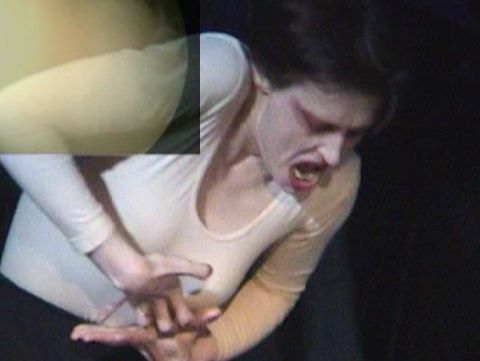
“Knee” emerges as a quintessential artifact within Ute Kilter’s expansive creative cosmos, a trailblazer in Odessa’s posthuman video lexicon. The work splices raw footage of the artist’s knee surgery – both external and visceral – into a disjointed tapestry interwoven with her performative acts, archival echoes of the Ukrainian National Republic, and the First World War’s spectral residue. This fusion ruptures the corporeal; thrusting the viewer beyond the organic into a realm where the self is both dissected and reconfigured. From 1993 to 2000, Kilter – artist, performer, actress, curator – transgresses the human medium, infiltrating television with Situation Ute, a conduit for contemporary art’s unbound potential. Alongside Viktor Malyarenko, Kilter’s practice melds performance, video, and film into an experimental singularity, dissolving the anthropic frame to unveil a fragmented, posthuman Odessa – one where identity splinters and history mutates into a boundless continuum.

AntiGonna: Battle of Coal
This creation emerges as a visceral echo of the disintegration wrought by Russian terrorism, transcending mere human suffering to probe the erosion of the anthropocentric self. Fusing theatrical abstraction with documentary fragments, it dismantles the boundaries of traditional perception, thrusting us into a posthuman confrontation with a fractured reality. Here, creativity and imagination become tools not for solace but for reconfiguring consciousness beyond the fleshly confines of victimhood. The performance pulses as a signal – a demand to shed the obsolete human framework, urging a reimagined existence unshackled from terror’s lingering spectre, where peace and justice are not endpoints but emergent states of a boundless, posthuman continuum.
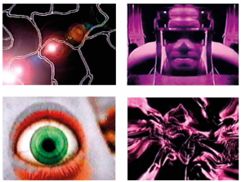
Philip Perlovsky: Eye am zoom
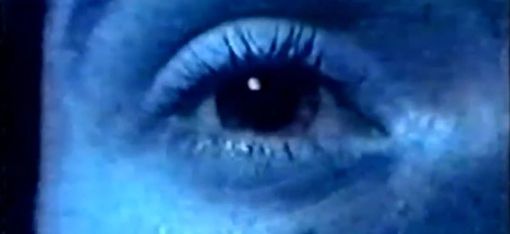
Philip Perlovsky is a video artist from Odesa. In his 1993 work, he presents a psychedelic visual narrative where the central image is an eye that gradually enlarges, unveiling multilayered strata of memory, horror, and personal recollections. This piece can be seen as a profound immersion into the inner world of consciousness, teetering on the boundary between human and posthuman existence, reflecting the transformation of subjectivity in an era of technology and the disintegration of traditional notions of identity.
The theme of horror in Perlovsky’s work may be interpreted as a response to the post-Soviet transitional period, a time when old structures were collapsing and new ones had yet to take shape, leaving the individual in a state of uncertainty and fear of the unknown. The psychedelic style here serves not merely as an aesthetic device but as a means to convey the fragmentation of consciousness, its attempt to comprehend itself in conditions where traditional categories of the “self” lose meaning.
Thus, the eye becomes more than just an organ of sight – it transforms into a portal to a posthuman state, where memory and horror exist as autonomous entities, detached from the subject that gave rise to them.
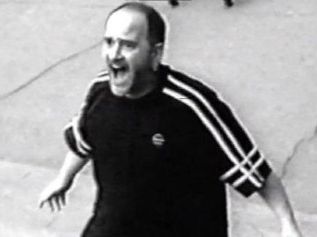
Olexandr Roitburd: The Psychedelic Invasion of the Battleship Potemkin into the Tautological Hallucinosis of Sergei Eisenstein
Oleksandr Roitburd’s video “The Psychedelic Invasion of the Battleship Potemkin into the Tautological Hallucinosis of Sergei Eisenstein” presents an actual look at the famous film by Sergei Eisenstein ” the Battleship Potemkin”. Eisenstein dedicated the main part of the film to the scene of the Odesan execution by the tsarist soldiers on the Grand Staircase. This scene was his complete invention, but the frames of this non-existent story are recognized as one of the best in world cinematography.
Roitburd re-edited the footage of the film and added modern scenes to them. The video begins with a man wearing a monkey mask sitting on the stairs and playing the violin. On the stairs joyful Odesans from the past and from the present are standing, waving their hands and greet everyone. This scene serves as a bridge between different eras. On the stairs from Eisenstein’s film there appear: a figure with stumps of legs and ladies with an umbrella and a lorgnette, who kindly wave to someone. Present time people also hug and kiss. Among them is the author of the video. All frames are repeated three or four times. Excessive joy gives the whole scene a comic quality.
vSuddenly, the shooting begins. A man with a monkey’s head falls from the stairs, boys on roller skates fall too. Other present time characters also scream in terror and fall. People in the film run down, not paying attention to those who have already fallen. We may also see legendary characters: a pram rolling down the stairs, a murdered child and a woman carrying it, a murdered woman in pince-nez, a man crushed by running people, many classic tragic film shots that become their opposite through multiplied repetitions. After that, it is impossible to believe Eisenstein‘s film. The video ends with Roitburd finishing playing on the violin and falling down, shot.
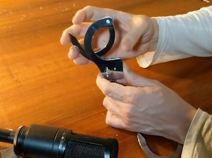
Oleksiy Shmurak: ASMR Interrogation
ASMR (an acronym for Autonomous Sensory Meridian Response) is a sensation of relaxation produced by various stimuli of an auditory and visual nature that indicates a trend that is widespread on the web today. The artist disrupts the most innocuous conception of this mass entertainment phenomenon by making an unusual ASMR video in which stimuli and sensations of pleasure are produced through objects symbolizing violence and coercion.
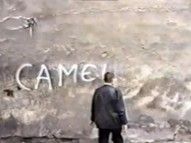
Ute Kilter and Victor Malyarenko: Die Strasse
The video “Die Strasse” by Ute Kilter and Victor Malyarenko begins with a demonstration of a busy street in a big city. We see the author rushing to the mesh fence, which appeared unexpectedly. The co-author appears in the frame, with a short haircut and in a man’s suit. They separately approach the wall with the inscription “camel”. Vladimir Lenin’s speech against capitalism is heard in the background.
This is followed by a dance next to a net that is weaving by some persons. The authors also take part in weaving. Short passages of phrases; news fragments; pedestrians walking down the street are repeated again and again. The author and the authoress again and again throw themselves at the mesh fence in different variations. They try to climb over it from the opposite sides of the fence to meet each other. Sometimes they almost succeed, so they try to do it again. But all in vain. Everyone stays behind his/her own side of the fence. In the final, a group of persons performs a dance near the net. To some extent, this world acquires features of mystical infinity and inevitability, and all actions in it became senseless.
In their work, the artists create an atmosphere of despair and hopelessness that prevail in the life in conditions of limitations.There are many symbolic frames in the video: the word “camel” is a symbol of a difficult journey through the desert of social difficulties; fast-changing news highlights the instability of modern life; unsuccessful attempts to climb over the fence that is completely unfunctional – a senseless desire to escape the hopeless oppression of social restrictions. This is an endless struggle for unattainable freedom, for self-realization in a world where borders and barriers become part of everyday life.
The work of Ute Kilter and Viktor Malyarenko demonstrates what human freedom is like in conditions where social, political and cultural structures impose invisible fences, and what the life is where a fence, a net and communist propaganda are mandatory elements of existence.
Dasha Chechushkova: intermezzo
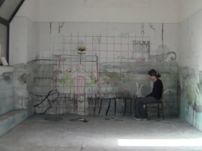
This piece reflects on the emotional experience of witnessing war from afar, while living in another country. Rather than illustrating distance directly, the artist conveys a sense of confinement and inner tension. Within the secluded setting of her studio, she builds dreamlike scenes – fragments of memory and imagination – layer by layer, constantly reworking them. The result is an animation that blurs personal and political boundaries, unfolding like a tense visual essay or a shadowy, surreal tale.
Trigger warning: The last three works contain depictions of violence.
Supported by:

MQ Raum D