ENZA
Lea Fröhlinger & Cosma Kremser
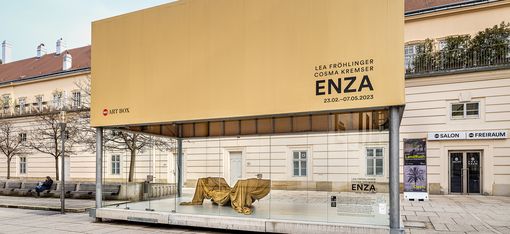
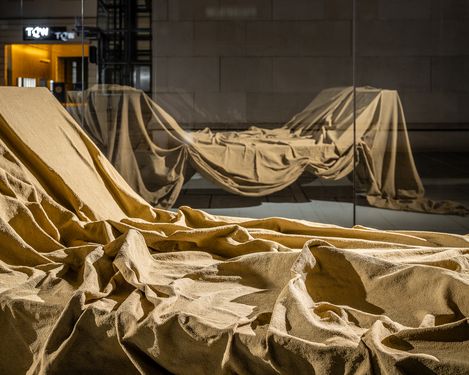
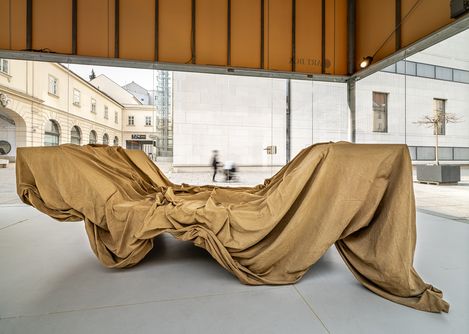
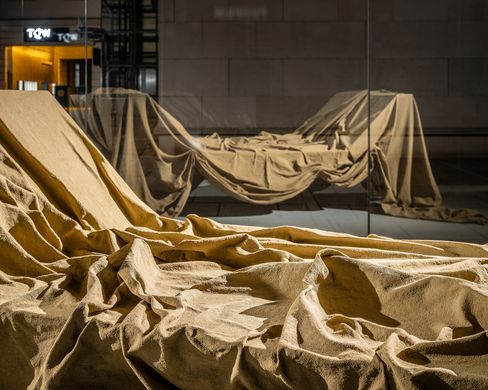
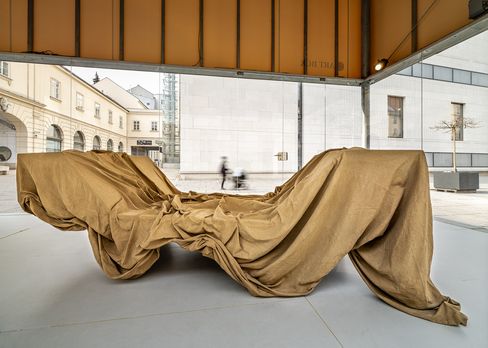
Clay is a renewable building material—when used responsibly, it returns to the soil without polluting the environment or causing indirect harm. It can be extracted locally and on a small scale. Students from TU Wien, the artists Cosma Kremser and Lea Fröhlinger, have worked intensively with Luisa Mihalyi to explore the material and developed a site-specific installation for the MQ Art Box: A cloth floats in the space and drapes over something that is no longer there yet remains present. Like a dystopian greeting from the world after mass production, the Enzi street furniture, designed by the architects PPAG, Anna Popelka, and Georg Poduschka, is playfully commemorated with a fleeting monument.
The futuristic-looking installation made of clay, jute, and wood oscillates between lightness and solemnity, subverting conventional notions of sustainable materials: the heavy becomes light, the traditional becomes modern, the ecological becomes aesthetic, and the airy provides support.
The textile-like weightlessness of ENZA is made possible by the use of clay and reflects the material’s minimal ecological footprint. Working with clay often involves consciously unlearning Western design strategies based on efficiency and standardization that aim for permanence. In many regions, traditional earthen construction leads to collective, cyclical maintenance work on buildings. The structure is understood as a process that involves the entire community and is accompanied by celebrations, rather than as a finished product. Thus, the regular maintenance of the built heritage becomes an interactive engagement with cultural roots. This approach is based on an alternative concept of eternity that is tied less to materials than to memory. In light of our overcrowded, globalized world, this represents an exciting alternative that pays tribute to the
ephemeral.In this
sense, the ENZA building instructions are meant as a form of democratization: anyone can build this monument—and modify it according to their own ideas. It will not be possible to recreate it exactly the same way a second time. Fortunately. The Ikea reference in the layout should be understood here as an ironic allusion to the capitalist mass production that ENZA opposes.
The Enzi furniture, which defines the identity of the MuseumsQuartier, transforms the urban space into a living room. The idea of the collective activation and use of public space has been very much in line with New Urbanism since the 1980s. Upon closer inspection, this is a sustainable concept that has been put into practice for millennia and is now becoming forward-looking.
A collaboration with the Architekturzentrum Wien and the TU Wien. The artists would like to thank Angelika Fitz, Andrea Rieger-Jandl, Christoph Lachberger, and Abbas Mussawi, as well as the TU Wien, Institute for Architectural History and Research.
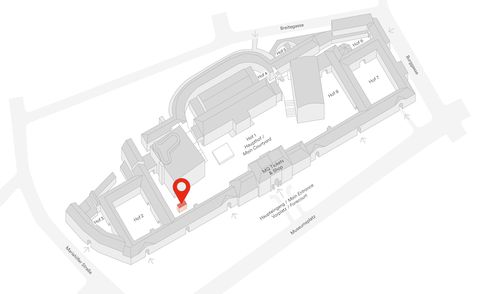
MQ Art Box