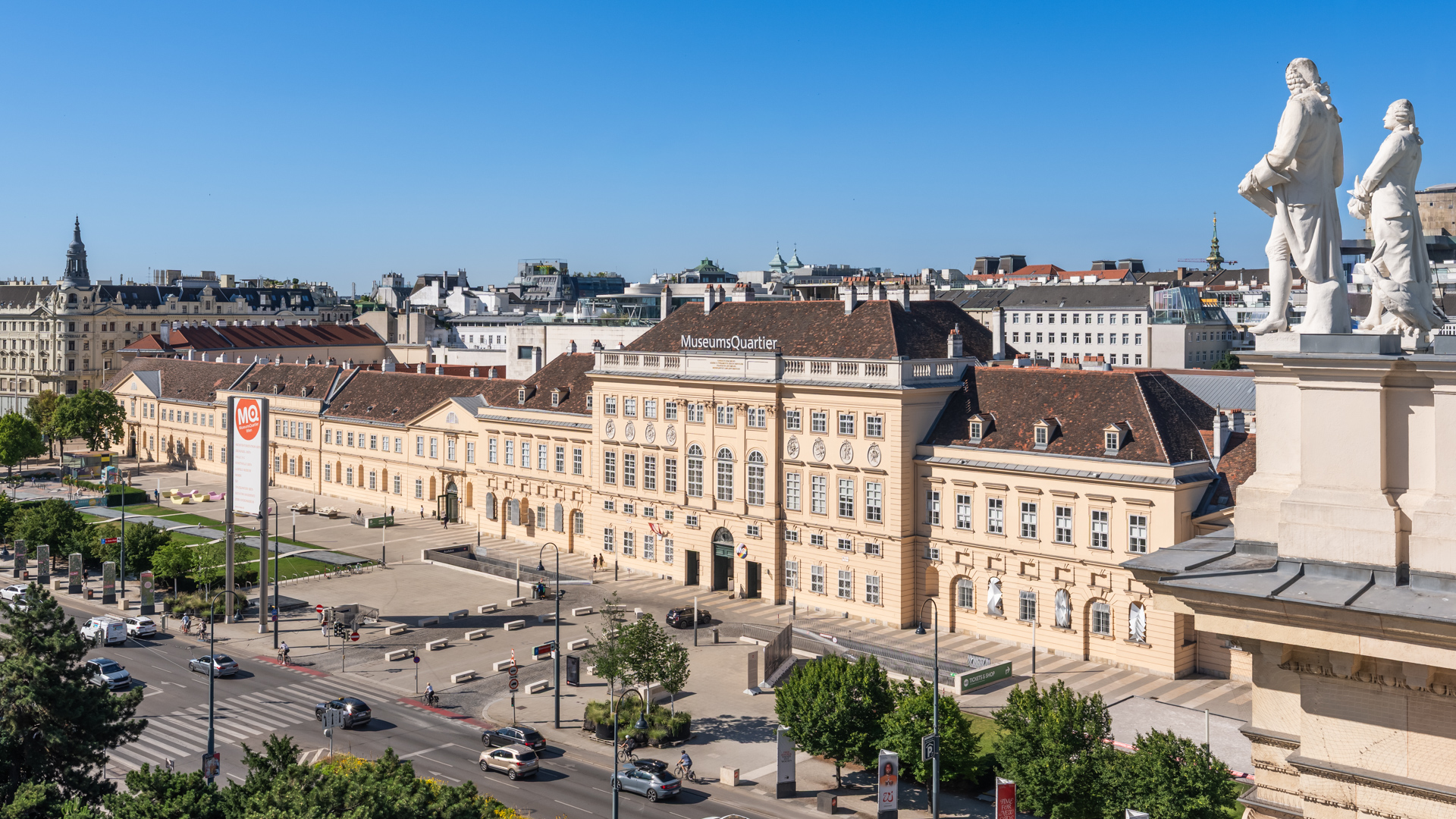
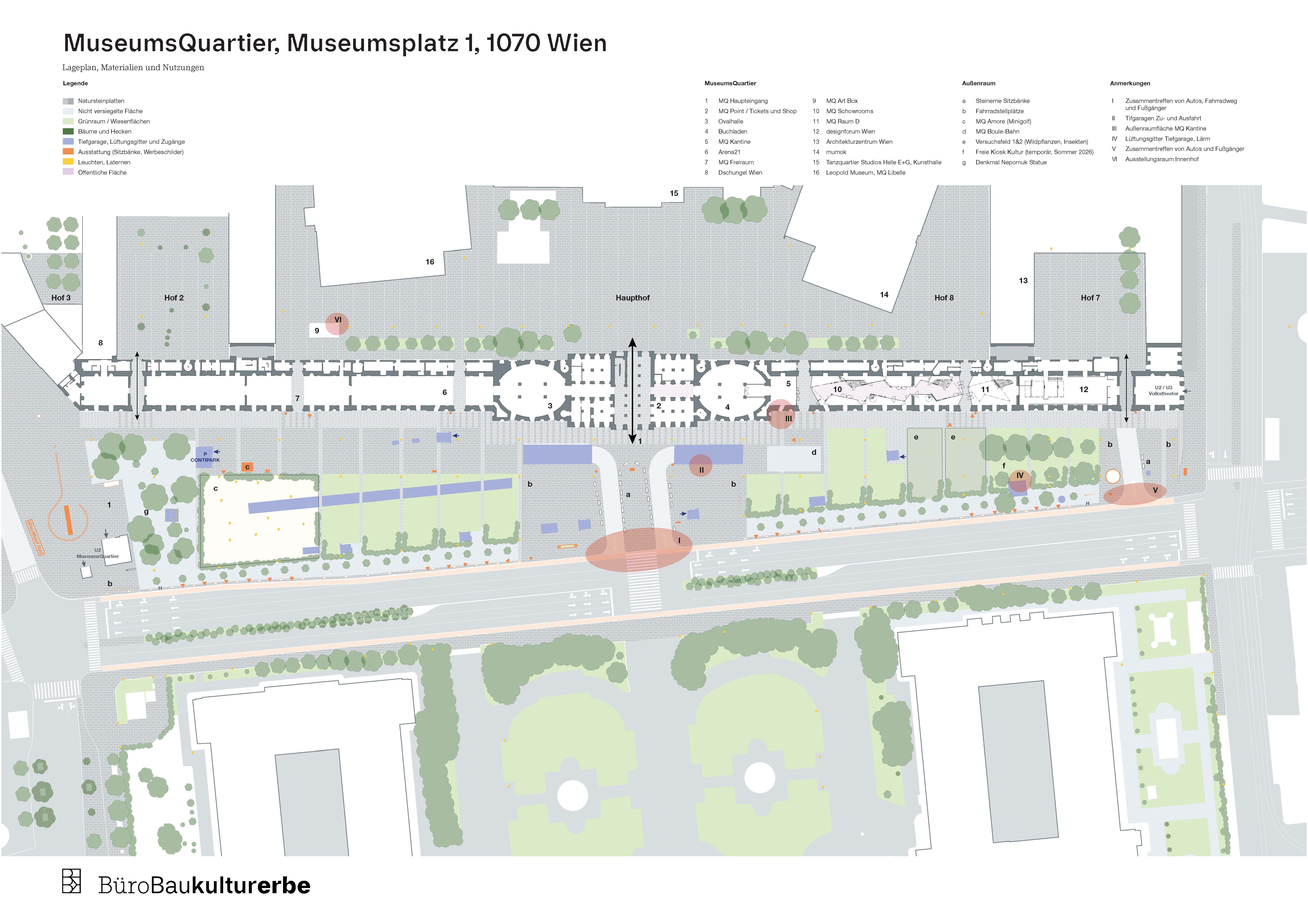
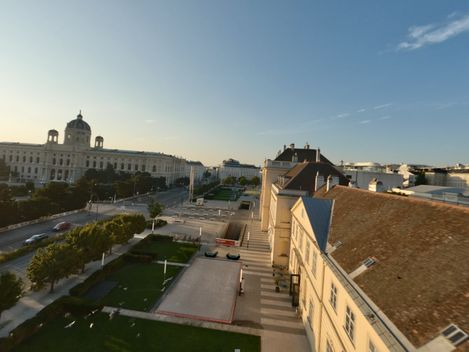
Panoramic video of the MQ forecourt
A panoramic photo of the MQ forecourt is available for download.
12.11.2026
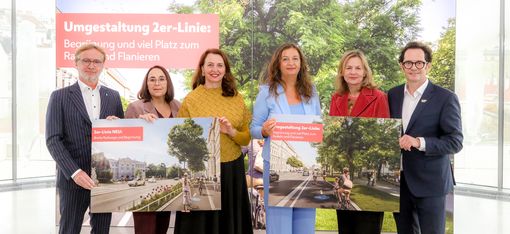
As part of the subway construction project, a total of 1.5 km between Universitätsstraße and Mahü will be redesigned by 2030—retaining two car lanes and adding new bike lanes
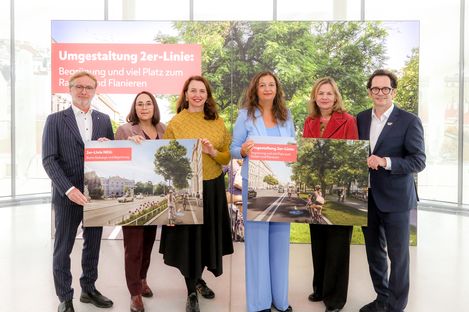
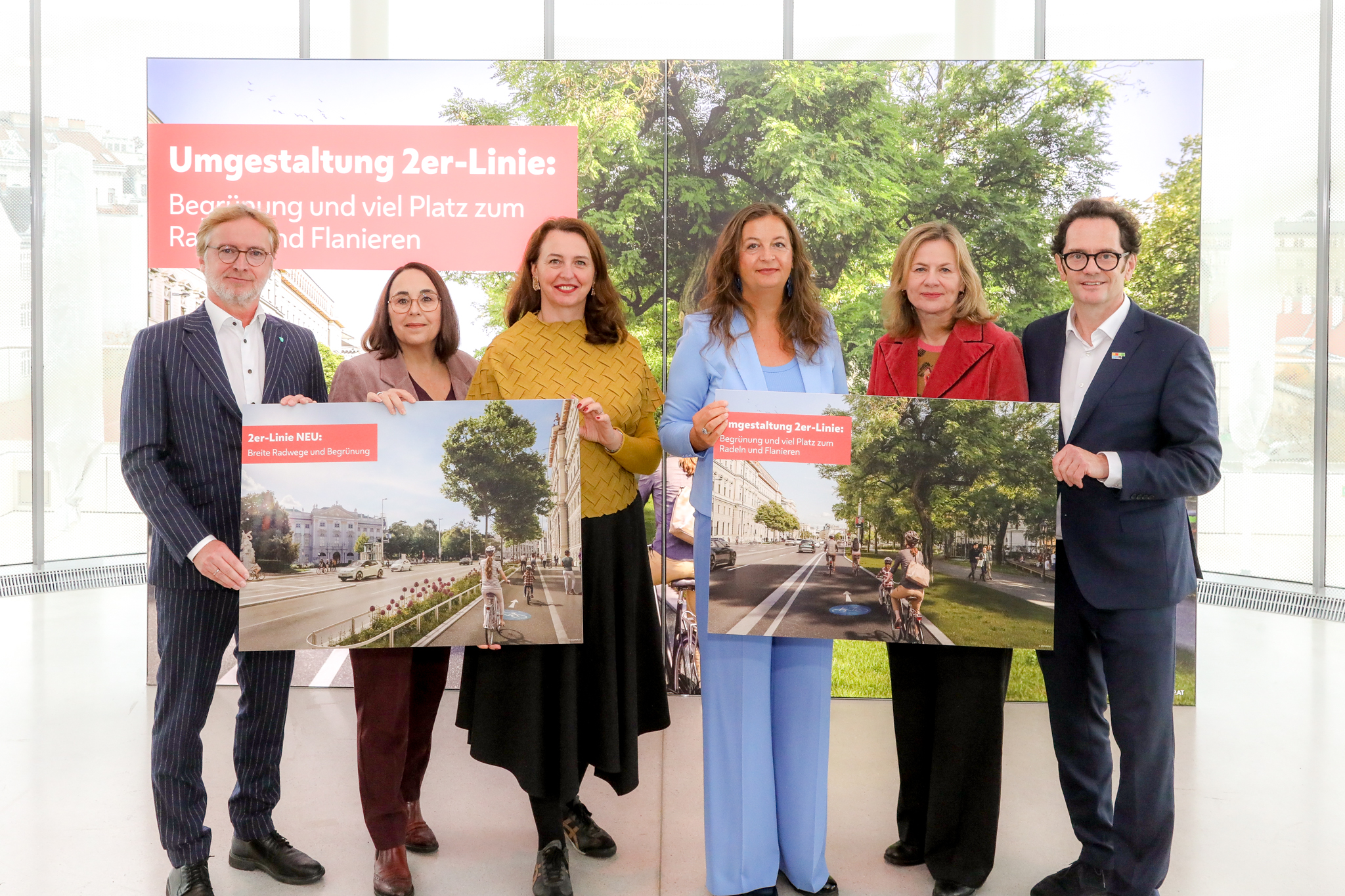
A major transformation for the famous Line 2: As subway construction is currently in full swing, the City of Vienna is seizing what is likely a once-in-a-lifetime opportunity to completely redesign this 1.5-kilometer stretch of street between Universitätsstraße and Mariahilfer Straße by 2030. Currently, the subway construction sites have led to various detours and temporary arrangements, which will be a thing of the past once the subway construction is completed in 2030. Along with the Ring and the Gürtel, Line 2 is a key main thoroughfare. The redesign will maintain a consistent layout of two lanes plus turning lanes, and new, wider bike lanes will be built in both directions. There will also be improvements for pedestrians, including safe crossings, 600 square meters of new green space, and 9 new trees.
The redevelopment will begin in 2027 with the section along Auerspergstraße and Museumsstraße between Josefsgasse and Burggasse. This will also create a connection to the Pfeilgasse bike lane. In 2028, the section from Burggasse to Mariahilfer Straße will follow—with a connection to the bike path at Getreidemarkt, the Mariahilfer Straße shared-space zone, and the Ring. In the subsequent years through 2030, the section on Landesgerichtsstraße between Universitätsstraße and Josefsgasse will be completed.
“We are taking advantage of the historic opportunity presented by the subway construction to redesign the 1.5-kilometer-long Line 2 in several sections. We are creating two uniform lanes while also establishing attractive bike paths. In particular, along Weghuberpark near the Ministry of Justice, the ‘slalom course’ around the streetlights is truly not in line with modern infrastructure on this important corridor toward Mahü, Naschmarkt, and Karlsplatz. “I would like to thank all the departments involved, the Mobility Agency, and the districts for their excellent cooperation on this very important project,” said Vienna’s City Councilor for Mobility, Ulli Sima, at today’s presentation of the plans.
Selma Arapovic, chair of the NEOS Vienna club, also emphasizes: “As Vienna’s main transit line, Line 2 must have well-developed and safe routes for pedestrians and cyclists. In the spirit of sustainable urban planning, we are using the subway expansion as an opportunity to create attractive public spaces. In addition to important improvements, a clearer separation of bicycle and pedestrian traffic will not only enhance the safety of road users but also improve visibility at intersections and the quality of the public space.”
Wide one-way bike lanes in both directions
The bike paths along the No. 2 line will be significantly widened on both sides. Depending on the section, they will be between 2.40 and 2.90 meters wide in the future. The situation will improve significantly near Weghuberpark: The currently very narrow bike path along the streetlights will be widened from about one meter to 2.90 meters.
The redesign also improves safety at intersections. Conflicts between vehicles turning right and cyclists traveling straight ahead—such as on Neustiftgasse—are mitigated by separate traffic light phases. This makes cycling more comfortable and safer.
Greater convenience for pedestrians
Pedestrians will also benefit from the redesign. In areas such as the one in front of the Volkstheater, bicycle and pedestrian traffic will be more clearly separated in the future. Cyclists will no longer be routed through areas heavily used by pedestrians, but will instead travel along the roadway. This will create more space, improve wayfinding, and reduce conflicts in public spaces.
“The redesign of Line 2 brings significant improvements, especially for cyclists. We expressly welcome this. The subway construction offers a rare opportunity to redesign one of Vienna’s most important street spaces for the coming decades, an opportunity we should take advantage of. From Josefstadt’s perspective, it is particularly crucial that, in addition to modern transportation infrastructure, sufficient consideration be given to greening, reducing impervious surfaces, and enhancing the quality of the public space. The planned 9 additional trees and 600 square meters of new green space in the first two sections are a first step. “We welcome these improvements and hope that, as planning progresses, additional opportunities will arise to design this important urban space in a way that is climate-friendly and livable,” said Martin Fabisch, district mayor of the 8th District.
“The No. 2 line is a major transportation corridor in Vienna, and its infrastructure must keep pace with changes in mobility patterns. Especially near Weghuberpark and at the entrance to the Museumsquartier, our district has long pushed to reduce accident hotspots and make cycling safer. The pioneering work of my predecessor, Thomas Blimlinger, over 20 years ago—building the first bike lane along Line 2—was a response to the growing importance of cycling. Now the task is to continue on this path and thereby make a further contribution to strengthening eco-friendly transportation and supporting the Smart Climate City strategy. “As a district, we have put forward our own proposals. It is important that we continue to develop these changes together with the city and find compromises: Good solutions for public spaces arise through collaboration and must take into account the needs of all road users,” emphasizes Markus Reiter, District Chairman of the 7th District.
Julia Lessacher, the district chairwoman of the 6th District, is pleased with the improved connectivity: “The new bike path along the former Line 2 route is a boon for Mariahilf: It will be wider and thus more comfortable, and it connects directly to the bike path at Getreidemarkt. Cyclists from the 6th District can now travel via a continuous, physically separated route from the 8th District to Gumpendorfer Straße or the Naschmarkt. This improves the efficiency of the bike route and enhances cyclists’ sense of safety.”
The MuseumQuartier's forecourt is being redesigned for the future
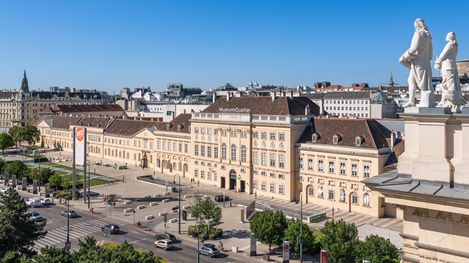
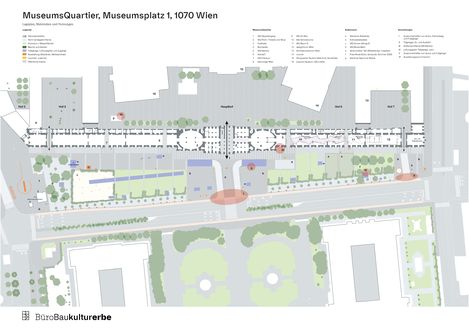
The redesign of Line 2 presents an opportunity to further develop the MuseumQuartier’s forecourt as well. As part of the comprehensive sustainability initiative “MQ goes Green,” launched by MQ Director Bettina Leidl in 2023, the MQ forecourt is now set to be redesigned to meet future needs. To this end, a landscape architecture and architectural design competition will be announced in the spring of 2027.
Special attention is being paid to the mature trees in the so-called “Wäldchen” as well as the tree-lined avenue along the Zweier line. The trees are to be gradually replaced with climate-resilient species, and the water-bound pavement will be opened up. Accessible paths, more seating and shaded areas, as well as improved pedestrian connections, are intended to enhance the quality of the space.
With approximately 14,334 m² of open space, the MQ forecourt is the largest open space in the 7th district. A total of 69 trees already characterize the square. Of the 5 million visitors each year, more than 3 million people pass through the MQ forecourt annually on their way to visit the MQ.
“A place with a rich history like the MQ, which is also a contemporary cultural space, must always be reimagined. The redesign of the Zweier-Linie presents an opportunity to further develop the MQ forecourt with improved infrastructure and more recreational offerings. With today’s landscape and architecture competition, we are setting the course to ensure that this area remains an open, diverse, and vibrant hub for art and culture for generations to come,” explains Bettina Leidl, Director of the MuseumsQuartier Wien.
With its “MQ goes Green” sustainability strategy, the MuseumsQuartier has outlined a vision for an energy-efficient and environmentally conscious arts and culture complex, with the goal of achieving climate neutrality by 2030. Climate-resilient outdoor spaces and the promotion of biodiversity are central pillars of this sustainability strategy.
Two lanes in each direction will remain
Two lanes in each direction will be maintained throughout the route for motor vehicle traffic. At intersections, additional lanes will be provided for turning vehicles and to accommodate traffic congestion.
Schedule at a Glance: Redesign
Media Spokesperson City Councilwoman Ulli Sima
Sophia Schönecker
Phone: +43 1 4000 82182 0676/8118 82182
Email: sophia.schoenecker@wien.gv.at
MuseumsQuartier Vienna
Anna Lena Schmidt, MA
Press and Public Relations | Editorial Department
M. +43 699 130 60 112
anna.schmidt@mqw.at | presse@mqw.at
The texts and images provided are protected by copyright and may be used exclusively for current reporting on the exhibition in question. If you have any questions regarding image rights, please contact the press office. Any other use or distribution requires prior written permission from the press team.