
Storm Protocols (Protocoles de tempête)
30.05. – 31.08.2026
ASIFAKEIL /
MQ Schauräume
03.08.2026, Interview MQ x VIENNA SHORTS
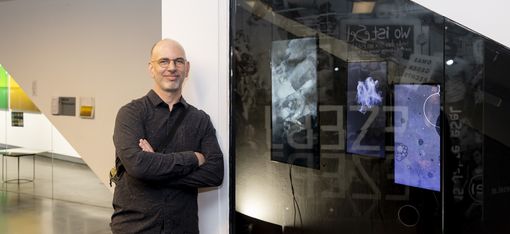
Your films, from Foreign Bodies to Squame to Entropic Memory, seem to return again and again to the body, to matter and to what resists being fully captured or preserved. Is there a central question that drives your practice across all these works?
Thank you for that observation; it touches on something genuinely central to this body of work. There is indeed a question that runs through all of these films, which I always conceived of as a whole: the question of the limits of representation of the human body, and the uncomfortable effects those limits can produce.
Early in this series, I often used the example of hearing a recording of your own voice, that strange, sometimes unsettling sense of distance it creates. As though the reproduction had nothing to do with our intimate experience of the body. That dissonance was my first source of inspiration.
The philosopher Alva Noë writes in his book The Entanglement (2023) that art is a practice of actively reorganizing experience. This enactivist thinking resonates deeply with something fundamental in stop-motion animation, where every gesture on matter is a negotiation with the real; a response one is searching for as much as constructing.
These three films recompose the time of the body, frame by frame, through photography. Foreign Bodies reconstructs the interior body around the myth of the transparent body and the medical imagery of the NLM Visible Human Project. Squame works the boundary, the skin, represented by emptied bodies cast in sugar, fracturing apart. And finally, Entropic Memory traces memory as it fades, slowly cleansed by the very time the film recomposes.
To answer your question directly: one could say that this trilogy follows a thread guided by the principle of the incompleteness of the representation of the sentient body, a real tension between lived experience and its confrontation with filmic matter. Experimental cinema, for me, is precisely the art of approaching what resists total capture. That is where its beauty lies: a dialogue between what matter wants and what our gestures offer it.
Entropic Memory began with family photo albums damaged by water, a deeply personal starting point. How did you find the balance between the private and the universal in this film, and at what point did the damaged photograph become a cinematic material rather than just a found object?
A long time ago, someone told me that what people mourned most after losing their home in a fire or flood was their family albums. Not furniture. Not valuables. The anchored images of loved ones. I did not think I was one of those people. I have few photos of myself, few photos in general. I am not sure whether it was losing my mother young, and the fact that several images of her disappeared in the flood that washed through the albums I kept in my basement, but I wanted to do something with that.
They stayed in boxes on my balcony for a few years, through several winters. Time and water did their work. By the time I decided to shoot, the images were already altered, made fluid, almost painterly. That may have been the precise moment those albums became cinematic material. The degradation of the photographs provoked something naturally; a feeling, a presence. It was almost too obvious. What I had not seen was the danger those images carried: they were covered in spores and mould, and shooting in my small, poorly ventilated apartment was neither healthy nor sustainable. I suppose there is always a moment in the creative process where the body itself is put at stake.
As for your question about the passage from the intimate to the universal: I believe that when I watch this film, I feel things that others will recognize in their own way, differently. There is a great deal of space in this film, many doors left open. In physics, entropy describes the inevitable movement of any system toward maximum disorder. Applied to memory, this idea speaks to everyone; we all know the experience of watching memories crumble, distort, lose their sharpness over time. The damaged family album is not only a personal object; it speaks to our human condition, to that desire and that brief capacity to preserve what is ultimately impossible to hold.
You won the Jury Prize for Outstanding Artistic Achievement for Mémoire entropique at VIENNA SHORTS 2025, and now you're back as Artist in Residence. What does it mean to return to the city, and how does an award like that change how you approach the next work?
Returning to Vienna feels like a small miracle. I am genuinely grateful to Vienna Shorts and to the jury who gave me this prize, one I consider among the most meaningful in the world of animation. Nowhere else is a prize directly tied to a one-month artist residency. That changes trajectories, without question.
For some time now, I have been living something of a triple life as a teacher, an administrator, and an artist. Roles that can be difficult to reconcile. This residency is therefore a precious window. It creates a new kind of legitimacy, one that allows you to follow your own intuitions further without feeling the need to justify them. There is something liberating in that. Being in Vienna is also to firmly position animation on the side of art, which is not always taken for granted. That is a real strength of Vienna Shorts and the MuseumsQuartier.
Spending a month at the heart of Vienna will allow me to forge connections, to open conversations and dialogues that I am convinced will nourish what comes next. I want to work differently in my upcoming films. The collective dimension of creation is drawing me more and more. Vienna may mark a turning point. I remain open.
Your Vienna residency culminates in a two-part exhibition at ASIFAkeil in MQ, first during the festival, then with new works added for another opening in June. You'll be showing your new work Storm Protocols, which turns its attention toward the atmosphere itself. Can you tell us a little bit more about it?
Storm Protocols is intended to mark a shift in my approach to experimental animation. After the body trilogy, Foreign Bodies, Squame, Entropic Memory, which explored the individual body, its boundaries, its memory, I wanted to turn my attention toward something more immersive and collective: the storm, the atmosphere, as a figure of our contemporary condition.
In its filmic form, the project is provisionally titled, in French, Recettes pour tempête annoncée, which translates roughly as Recipes for a Forecast Storm. The idea is to reconstruct a storm frame by frame, not through digital or generative means, but physically, through the direct manipulation of materials selected for their intrinsic properties: paper, foam, ferrofluid, sodium thiosulfate, cymatics, and so on. Each protocol provokes atmospheric dynamics into which I seek to insert myself, to capture them through direct manipulation or careful observation: the birth of a mesocyclone, the formation of a cumulus cloud, an apparition, a dissipation.
What interests me in the notion of atmosphere and storm is not the spectacle of disaster, but the question of attention. The phenomenologist Tim Ingold proposes that we do not inhabit a world of objects, but a world of mediums, of winds, lights, matter in motion. Atmosphere, for him, is not a backdrop: it is the very condition of our presence in the world. I also think of Peter Sloterdijk, who devoted a significant part of his thinking to spheres, those atmospheric, climatic, political, and affective envelopes in which we are immersed without always perceiving them.
To reconstruct a storm gesture by gesture is a way of refusing to be subjected to it, of revealing that intentionality, gesture, and choices of solidarity can transform the crossing. The project does not seek to culminate in the representation of disaster, but in the paradoxical emergence of calm: serenity not as the absence of storm, but as a quality of attention that a collective can cultivate in the face of the forces moving through it.
The recipe laboratories will be carried out in part collectively, testing protocols together, experiencing what each material can offer to animation, co-constructing. The residency at MuseumsQuartier will be the first ground for this exploration.
How do you think about building a show in stages like that? Is the second iteration a continuation, a response, or something more like a transformation of the first?
This format, where the gallery space becomes the creative laboratory itself, felt like the most honest approach. I see these stages as privileged moments for attempting to capture the spirit of a film-to-come through atmospheres: provisional states, intuitions made visible before what might become a film truly exists. In that sense, I do not yet know whether I will be in continuation, or in something closer to montage, moving from one atmosphere to another more overtly. That uncertainty interests me.
What I do know is that this structure is genuinely engaging for the creative work itself. It imposes a rhythm, an obligation to look at the work as it unfolds.
I therefore conceive of these two presentations above all as objects for contemplation and conversation. Invitations to look together at what is still in the process of finding itself.
Much of your work sits at the intersection of animation, installation, and immersive projection. When you arrive in a new city for a residency, how does the place feed into what you make?
It is a fine balance. Stop-motion animation demands a quality of attention, a kind of time and rigour that can consume everything. And yet it is precisely in the wandering, in the unscheduled moments, that inspiration arrives most naturally, without forcing.
Encounters with other residents play an important role. We are all in the same situation of production, far from our habits, and the exchanges are often very generative. No hierarchy, just people searching.
In concrete terms, I bring my small stop-motion shooting studio. For the rest, I let the magic happen. The city, its atmospheres, its unexpected encounters always end up entering the work one way or another, often where least expected.
It is always ambitious to want to produce and develop simultaneously, in a new place, with limited time. That is precisely the challenge here. But I will be in Vienna at full capacity: in the studio and in the city.
The focus theme of VIENNA SHORTS this year is Eyes Wide Open: Matters of Attention. Your work seems deeply concerned with how we look, remember, and perceive. What does 'attention' mean to you as a filmmaker and visual artist?
This question brings me back once again to Alva Noë, this time to Varieties of Presence (2012). His central idea is that the world is not given freely; it is conquered, constructed, negotiated. Presence is not passively received: it is achieved, through our engagements, our skills, our active attention. We ourselves must perform the act of presence, bringing with us what we have cultivated.
Questions of perception in the philosophy of mind have always fascinated me. One that preoccupies me in particular is the notion of the mental image, the way we represent the world internally, and how much this varies from person to person. We know today that we all sit somewhere on a spectrum of aphantasia: at one end, people who see mental images of nearly hallucinatory vividness; at the other, people who produce none at all. For me, this spectrum profoundly conditions our relationship to reality, our way of conceiving, memorizing, imagining. Images and editing effects in cinema often operate precisely in that space. A film does not produce the same experience in every mind.
This interest also led me, working with the NFB, to develop a telekinesis prototype, a brain-machine interface that used mental imagery as an active command, literally using thoughts to manipulate virtual and physical objects. This experience brought me to think differently about our relationship to control, often very relative, over the images of our own minds. Can one direct one's attention the way one directs a gesture? How far?
The notion of attention can become a tool of freedom as much as of control. A deeper understanding of these mechanisms is probably somewhat precious, for today and for tomorrow.